|
The Hebrew three-letter homograph shin bet/vet
tav (tbf),
when pronounced Shabbat, means Sabbath; when
pronounced shevet, it means dwelling; with an
added silent letter as shin ayin bet/vet tav
and pronounced shivat, it is the number
seven. The words Sabbath, dwelling, and seven are
related.
Sabbath is neither only for “Jews,” nor only for
some previous era. It was created for Adam – man,
and for eternity! It was created as the seventh day
of the week (sunset to sunset), never to change. It
is to be kept holy – meaning dedicated to our
Savior, in contrast to our other days of labor. It
is the time created for God to dwell with man – in
the original Eden (when God was finished with His
work of creation), in our weekly day to joyfully
meet with Him (setting aside our weekly work), and
in the future when Messiah will dwell in
Eden/Paradise with the meek who inherit the earth
(when our redemption is completed). Sabbath is a
glorious crown of God’s creation, when everything
says “Holy!”
DEFINITIONS
To be holy or sanctified (from Hebrew
vdq
- qadosh)
means to be set apart as dedicated to God. People,
places, times, and objects can be holy – set apart
as dedicated to God; the term holy does not
mean righteous, though dedicated people seek to be
righteous. Holiness may be decreed by God (i.e. for
Sabbaths) or by man (i.e. for voluntary offerings).
Sabbath is the seventh day of the biblical week –
from sunset Friday through sunset Saturday (“evening
and morning” in Genesis 1 meaning nighttime and
daytime).
Elohim
(usually translated “God”) is a common name for our
Creator representing Him as Judge of His Creation.
Yahweh (often
substituted with “LORD”) is the holy name of our God
representing Him as the Eternal who is gracious.
Yeshua (usually
translated “Jesus”) is the name of our savior given
through an angel (Matthew 1:21).
A. THE ERA OF SABBATH
1. From creation, the seventh day was a specific
time set apart by the Creator.
Genesis 1:31
31 Elohim saw all that He had
made, and behold, it was very good. And there was
evening and there was morning, the sixth day.
Genesis 2:3
Then Elohim blessed the seventh day and
sanctified it, because in it He rested from all His
work which Elohim had created and made.
The seventh day, when all of creation was
functioning peacefully as planned, was the Creator’s
goal of six days of creation.
2. Sabbath was understood by all those delivered
from Egypt, before the “Ten Commandments.”
Exodus 16:29
“See, Yahweh has given you the Sabbath;
therefore He gives you bread for two days on the
sixth day. Remain every man in his place; let no man
go out of his place on the seventh day.”
About twenty-five-hundred years after creation, as
Yahweh led His chosen people from various
nations out of Egyptian slavery, He fed them for six
days a week with bread from heaven – the people
called it manna (what’s this stuff?). On the
sixth day He gave twice as much, but none to gather
on the seventh day.
3. The fourth commandment is to remember the
Sabbath day that Yahweh made holy at creation.
Exodus 20:8-11
8 "Remember the Sabbath day, to keep it
holy. . . . 11 "For in six days Yahweh
made the heavens and the earth, the sea and all that
is in them, and rested on the seventh day; therefore
Yahweh blessed the Sabbath day and made it
holy.
The fourth item on the tablets given to Moses
required that people remember to keep the Sabbath
holy, because Yahweh had made it holy at
creation. Sabbath was created long before Moses.
4. Sabbaths were remembered through the apostolic
times.
Acts 15:21
21
For Moses from ancient generations has in every city
those who preach him, since he is read in the
synagogues every Sabbath.”
6. Sabbaths will be the same for a thousand future
years in this world.
Ezekiel 46:1-3
1 Thus says Lord Yahweh, “The
gate of the inner court facing east shall be shut
the six working days; but it shall be opened on the
Sabbath day and opened on the day of the new moon.
2 The prince shall enter by way of the
porch of the gate from outside and stand by the post
of the gate. . . . . 3 The people of the
land shall also worship at the doorway of that gate
before Yahweh on the Sabbaths and on the new
moons.”
During Yeshua’s millennial reign, Sabbath observance
will be the norm. The future millennial Holy Temple
and its ordinances are the subject of Ezekiel
chapters 40 through 47.
7. Sabbaths will be observed eternally in the
future world that is renewed by fire.
Isaiah 66:22-23
22 “For just as the new heavens and the
new earth which I make will endure before Me,”
declares Yahweh, “So your offspring and your
name will endure. 23 And it shall be
from new moon to new moon and from Sabbath to
Sabbath, all mankind will come to bow down before
Me,” says Yahweh.
The Sabbath that Elohim made holy at
creation, will be holy throughout the eternity of
the new creation.
The era of Sabbath is from creation to eternity!

B. THE PEOPLE OF SABBATH
1. From creation, the seventh day was set aside for
man to worship.
Genesis 1:27, 31
27 Elohim created man in His own
image, in the image of Elohim He created him;
male and female He created them. . . 31
Elohim saw all that He had made, and behold,
it was very good. And there was evening and there
was morning, the sixth day.
Genesis 2:3
Then Elohim blessed the seventh day and
sanctified it, because in it He rested from all His
work which Elohim had created and made.
Mark 2:27
Yeshua said to them, “The Sabbath was made for man,
and not man for the Sabbath.”
The day after Adam (man) was created, the seventh
day was proclaimed holy by its Creator. This Sabbath
was thenceforth a day for man to dedicate to the
worship Yahweh. Accepting the Genesis account
of creation requires acceptance of the seventh day
being set aside for the worship of the Creator.
2. Sabbath was enjoined for all of Yahweh’s
people upon deliverance from slavery of sin.
Exodus 16:29
“See, Yahweh has given you the Sabbath;
therefore He gives you bread for two days on the
sixth day. Remain every man in his place; let no man
go out of his place on the seventh day.”
About twenty-five-hundred years after creation, as
Yahweh led His chosen people from various
nations out of Egyptian slavery, He fed them for six
days a week with bread from heaven – the people
called it manna (what’s this stuff?). On the
sixth day, He gave twice as much, but none to gather
on the seventh day. No one was to go about working
to obtain food on the Sabbath.
3. Sabbath was explained to Israel, God’s agent to
enlighten the world.
Isaiah 42:6-7
"I am Yahweh, I have called you in
righteousness, I will also hold you by the hand and
watch over you, and I will appoint you as a covenant
to the people, as a light to the nations, 7
to open blind eyes, to bring out prisoners from the
dungeon and those who dwell in darkness from the
prison.
Exodus 20:8-11
8 "Remember the Sabbath day, to keep it
holy. 9 "Six days you shall labor and do
all your work, 10 but the seventh day is
a Sabbath of Yahweh your God; in it
you shall not do any work, you or your son or your
daughter, your male or your female servant or your
cattle or your sojourner who stays with you. 11
"For in six days Yahweh made the heavens and
the earth, the sea and all that is in them, and
rested on the seventh day; therefore Yahweh
blessed the Sabbath day and made it holy.
Leviticus 23:3
“For six days work may be done, but on the seventh
day there is a Sabbath of complete rest, a sacred
assembly. You shall not do any work; it is a Sabbath
to Yahweh in all your dwellings.”
Hebrews 10:25
. . . not forsaking our own sacred assemblies, as is
the habit of some, but encouraging one another; and
all the more as you see the day drawing near.-
Israel was set as a light to the nations by the
giving of the Torah through Moses. The fourth item
on the tablets given to Moses required that the Holy
Sabbath be remembered, because Yahweh set it
apart at creation. In subsequent explanation a
public worship service was required. Paul (assumed
author) emphasized this to the Hebrew believers.
4. Sabbaths were observed by Yeshua, and by His
apostles after His ascension.
Luke 4:16
And He (Yeshua) came to Nazareth, where He had
been brought up; and as was His custom, He entered
the synagogue on the Sabbath, and stood up to read.
Acts 17:2
And according to Paul's custom, he went to them (to
the synagogue at Thessalonica), and for three
Sabbaths reasoned with them from the Scriptures,
It was Yeshua’s custom to attend synagogue Sabbath
services. It was also Paul’s custom after Yeshua
left the earth. It may be noted here that
“synagogue” and “church” were not distinct words in
Hebrew – they are from Greek translations (synagoge
and ekklesia) of the same Hebrew word
qehal; the distinction in meaning is modern.
See article Qehal: Synagogue/Church.
5. Sabbath services were assigned for new gentile
believers.
Acts 15:19-21
(Apostle James speaking) 19
“Therefore it is my judgment that we do not trouble
those who are turning to God from among the
Gentiles, 20 but that we write to them
that they abstain from things contaminated by idols
and from fornication and from what is strangled and
from blood. 21 For Moses from ancient
generations has in every city those who preach him,
since he is read in the synagogues every Sabbath.”
New gentile believers were to first give up gross
idolatrous practices, and then learn at their local
synagogues every Sabbath.
6. Believers will observe Sabbaths for a thousand
future years in this world.
Ezekiel 46:1-3
1 Thus says Lord Yahweh, “The
gate of the inner court facing east shall be shut
the six working days; but it shall be opened on the
Sabbath day and opened on the day of the new moon.
2 The prince shall enter by way of the
porch of the gate from outside and stand by the post
of the gate. . . . . 3 The people of the
land shall also worship at the doorway of that gate
before Yahweh on the Sabbaths and on the new
moons.”
During Yeshua’s millennial reign, Sabbath observance
will be the norm. The future millennial Holy Temple
and its ordinances are the subject of Ezekiel
chapters 40 through 47.
7. Sabbaths will be observed eternally in the
future world that is renewed by fire.
Isaiah 66:22-23
22 “For just as the new heavens and the
new earth which I make will endure before Me,”
declares Yahweh, “So your offspring and your
name will endure. 23 And it shall be
from new moon to new moon and from Sabbath to
Sabbath, all mankind will come to bow down before
Me,” says Yahweh.
A holy people will honor the Sabbaths when all is
perfection and joyfulness!
8. Sabbaths an eternal sign of Yahweh’s
people.
Exodus 31:16-17
“16 So the sons of Israel
shall observe the Sabbath, to celebrate the Sabbath
throughout their generations as a perpetual
covenant. 17 It is a sign between Me and
the sons of Israel forever; for in six days
Yahweh made heaven and earth, but on the seventh
day He ceased and was refreshed.
Sabbath holiness is a mark of Yahweh’s
people!
C. THE PURPOSE OF SABBATH
1. The Sabbath Day is a memorial to Messiah as
creator and sustainer.
Exodus 20:8, 11
8 "Remember the Sabbath day, to keep it
holy. . . . 11 "For in six days
Yahweh made the heavens and the earth, the sea
and all that is in them, and rested on the seventh
day; therefore Yahweh blessed the Sabbath day
and made it holy.
Colossians 1:15-17
15 He (Messiah Yeshua) is the image of
the invisible God, the firstborn of all creation.
16 For by Him all things were created,
both in the heavens and on earth, visible and
invisible, whether thrones or dominions or rulers or
authorities-- all things have been created through
Him and for Him. 17 He is before all
things, and by Him all things are sustained.
In remembering the Sabbath that was made holy
(distinct from other days) at creation, we are
acknowledging the Messiah as creator and sustainer.
2.
The
Sabbath Day is instructive, with the goal to know
and love Messiah.
Romans 10:4
For Messiah is the goal of the Torah (Genesis
through Deuteronomy), to make righteous everyone who
believes.
Sabbath is part of our Creator’s instruction –
Torah, which has been given to lead us to the
righteousness which is of faith in Messiah. Note
that Paul here uses present tense referring to the
Torah and its goal for Roman gentile believers.
Leviticus 23:3
. . . on the seventh day there is a Sabbath of
complete rest, a sacred assembly. . .
Acts 15: 21
For Moses from ancient generations has in every city
those who preach him, since he is read in the
synagogues every Sabbath.
A sacred assembly – a public service with Biblical
instruction is prescribed for Sabbath, through both
Moses and the apostles.
3. The Sabbath Day is a prophetic picture of the
Messianic Kingdom
Colossians 2:16-17
16 Therefore let no one condemn you in
regard to food or drink or in respect to a festival
or a new moon or a Sabbath day – 17
things which are a prophetic shadow of what is to
come; the body casting the shadow being Messiah.
The apostle Paul is here speaking to gentiles at
Colossae, long after Yeshua’s crucifixion,
resurrection, and ascension. He is telling them to
let neither Jew nor gentile condemn them for keeping
the eternal ordinances of Yahweh, because
Messiah Himself is thus giving us a shadow picture
of His future Kingdom.
2 Peter 3:7-8
7 But by His word the present heavens
and earth are being reserved for fire, kept for the
day of judgment and destruction of ungodly men.
8 But do not let this one fact
escape your notice, beloved, that with the Lord one
day is like a thousand years, and a thousand years
like one day.
The six days of creation parallel six millenniums of
this world, as a prophetic picture, culminating with
judgment and the Sabbath Millennium when Yeshua will
reign.
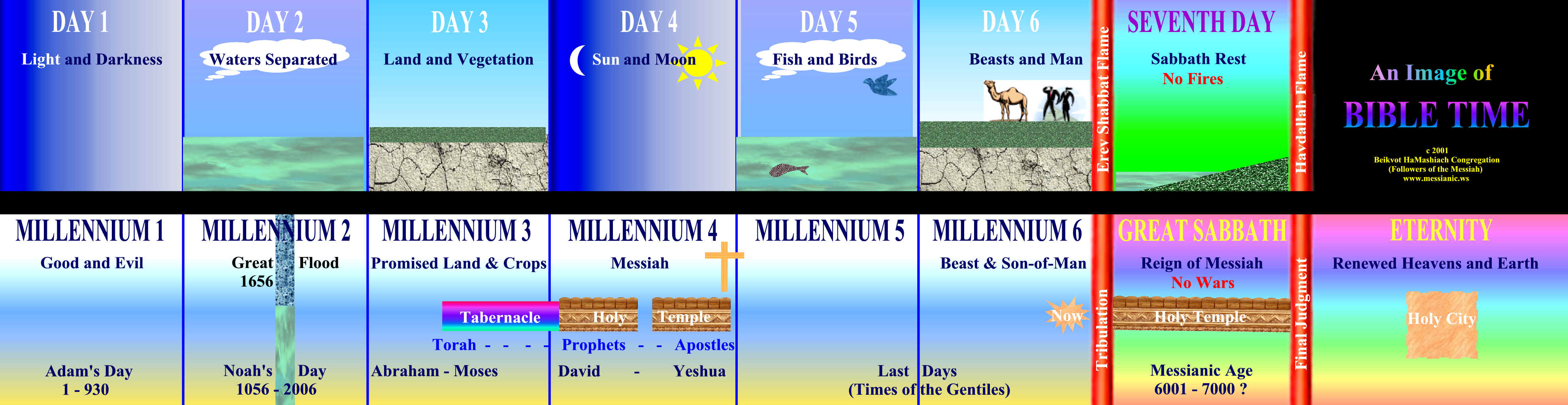
God is “declaring the end from the beginning” –
Isaiah 46:10. From the beginning – six days of
creation and a Sabbath, we see the end of this world
prophetically declared – six millenniums and the
thousand-year reign of Messiah. It is written, “one
day is with Yahweh as a thousand years, and a
thousand years as one day,” referring specifically
to the end of this world.
On day one of creation, God differentiated
between light and darkness. In the first millennial
day, Adam’s day, man learned to differentiate good
and evil. God told Adam that he would die the day he
ate of the fruit of knowledge; he died before the
end of his first millennial day, at age 930 –
Genesis 5:4.
On the second day of creation, God separated
the waters under the firmament from those above. In
the second millennial day, Noah’s day, God “opened
the fountains of the deep” and “the windows of
heaven” and brought the waters back together to
flood the earth, then separated them again forever.
Noah lived most of the second millennium (from AM
1056 - 2006, 950 years – Genesis 9:29). The great
flood was in the 600th year of Noah’s
life, AM 1656.
Only upon completion of the second day did God not
say that it was good. The sages say that the angels
were created on this day.
On the third day of creation, God brought
forth dry land and vegetation. In the third
millennial day, Abraham’s day, God gave His people
the land of Canaan with bountiful vegetation.
Abraham, Isaac, Jacob and Moses were of this day.
On the
fourth day of creation, God set the sun and moon
in their places. The moon is seen by the sages as a
symbol of Messiah. The fourth millennial day is the
day of Messiah. (Messiah means the anointed one; men
were anointed to be King of Israel, Priest of the
Most High God, or Prophet of Jerusalem.) David was
the forerunner Messiah King at the beginning of this
day (shortly after AM 3000), and Yeshua came as the
ultimate Messiah King, Priest, and Prophet near the
end of this day (before AM 4000).
Interestingly, the Talmud says that Messiah should
have come in the fourth millennium, but because
Israel was so sinful, He would not come until the
end of the sixth millennium. But He did come in the
fourth, and He will also come in the end of the
sixth! (This is not to imply a certain year.)
The fifth and sixth millennial days are
referred to as the last days – 2 Peter 3:3. On the
sixth day, after creating beasts, God said, “Ki Tov”
– it is good / finished. Then He created man. When
everything was finished, God said, “Tov M’ode” –
very good. It all worked together as planned.
The sages say, “End of deed, first in thought.”
Before a builder starts a foundation or forms walls,
he has a final house plan in mind. God spent six
days creating the heavens and the earth, with the
end deed being the Sabbath; but the Sabbath was the
original goal, the first in thought.
The purpose of Sabbath is memorial, instructive, and
prophetic – and altogether messianic.
D. HOW THE SABBATH IS SANCTIFIED
1. The Sabbath Days, and Sabbath Millennium, are
Set Apart for Messiah to Dwell With Us
Matthew 1:22-23
22 Now all this took place to fulfill
what was spoken by the Lord through the prophet:
23 "Behold, the virgin shall be with
child and shall bear a son, and they shall call His
name Immanuel," which translated means, "Elohim
With Us."
Revelation 20:6
Blessed and holy is the one who has a part in the
first resurrection; over these the second death has
no power, but they will be priests of God and of
Messiah and will reign with Him for a thousand
years.
The Hebrew word
tbf
is both Shabbat (Sabbath) and shevet
(dwelling): it is the time when Immanuel (The
Creator-Judge With Us) dwells with us in a special
way.
When Yahweh dwelt over the Ark in the Tabernacle and
Temple, the gates were open on the Sabbaths for the
people to have Him in their midst.
In a future time, Messiah will dwell and reign on
this earth for a thousand years, known as yom
shekulo Shabbat – the day when all will be
Sabbath.
2. The Sabbath Day is to be distinguished by us –
marked-out from other days.
Ezekiel 20:20
“Sanctify My sabbaths; and they shall be a sign
between Me and you, that you may know that I am
Yahweh your God.”
On Erev Shabbat, that is
on Friday before sunset as the Sabbath approaches
each week, we pronounce a blessing and light Sabbath
candles. For Havdallah, that is after
Saturday’s sunset at the end of each Sabbath, we
pronounce a blessing and light a special bright
candle, then extinguish it in a glass of grape juice
or wine. By lighting fires just before and after the
Sabbaths, we symbolically “make separate (God’s)
Sabbaths” – during which we are forbidden to light
fires (Exodus 35:3).
This ancient symbolic means of
sanctifying the Sabbath seems prophetic: the Sabbath
Millennium will be preceded (Erev Shabbat) by
the fires of war of the great tribulation
(Revelation 16). It will be followed (havdallah)
by fire from heaven being quenched in the blood of
the wicked (Revelation 20:7-9). There will be a
thousand years of Shabbat Shalom (Sabbath peace)
between the fires that make the Sabbath separate
(Revelation 20:1-6).
3. Sabbath is to be the climax of each week.
Genesis 2:3
Then Elohim blessed the seventh day and
sanctified it, because in it He rested from all His
work which Elohim had created and made.
Leviticus 23:2-3
2 “Speak to the sons of Israel and say
to them, ‘Yahweh’s appointed times which you
shall proclaim as sacred assemblies – My appointed
times are these:
For six days work may be done, but on the seventh
day there is a Sabbath of complete rest, a sacred
assembly. You shall not do any work; it is a Sabbath
to Yahweh in all your dwellings.’”
Elohim
had a plan for the six days of creation, so that on
the seventh day He would rest with everything
functioning and at peace. Likewise we are to work
for six days each week, so that on the Sabbath we
can set aside mundane cares to focus on our Creator
and Savior with everything functioning and at peace.
A sacred assembly – that is a public worship service
– is part of the Sabbath blessings. It is an
appointed time to meet with God at a sacred place –
a place set apart to hear His Word and offer praise.
The terms “complete rest” and “no work” are not
without clarification from other Scripture. The
Sabbath day is to be set apart for our Creator and
Savior, with a public worship service included. Some
work takes precedence, including food preparation
and any work to sustain life and health, which
cannot reasonably be performed prior or be delayed.
The idea of rest is to set aside other endeavor in
order to worship, not to catch-up on rest from
working too hard other days. Also, there are certain
positions – such as priests and mothers of infants,
having duties that supersede Sabbath restrictions.
4. Keeping Sabbath holy includes a sacred public
meeting.
Leviticus 23:3
For six days work may be done, but on the seventh
day there is a Sabbath of complete rest, a sacred
assembly. You shall not do any work; it is a Sabbath
to Yahweh in all your dwellings.
Hebrews 10:24-25
24
Let us consider how to stimulate one another to love
and good deeds, 25 not forsaking our own
assembling together, as is the habit of some, but
encouraging one another, and all the more as you see
the day drawing near,
Sabbaths are to be kept holy – dedicated to the
worship of God, which is to include a sacred
assembly for prayer, singing Psalms, and learning
God’s Word. Forbidden activities include all
commercial endeavor and buying and selling (Nehemiah
10:31), carrying items out of our houses (Jeremiah
17:22), and dealing with tithes and personal
offerings (1 Corinthians 16:2). Exceptions include
necessary food preparation (Exodus 12:16); caring
for children, the weak, and the sick; and emergency
response.
5. Sabbath observance is designed to be a joy.
Isaiah 56:6-7, 13-14 6
“Also the gentiles who join themselves to Yahweh,
to minister to Him, and to love the name of
Yahweh, to be His servants, everyone who keeps
from profaning the Sabbath and holds fast My
covenant; 7 even those I will bring to
My holy mountain and make them joyful in My house of
prayer. Their elevation offerings and their
sacrifices will be acceptable on My altar; for My
house will be called a house of prayer for all
people.”
13
“If because of the Sabbath, you turn your foot from
doing your own pleasure on My holy day, and
call the Sabbath a delight, the holy day of
Yahweh honorable, and honor it, desisting
from your own ways, from seeking your own
pleasure and speaking your own word, 14
then you will take delight in Yahweh, and I
will make you ride on the heights of the earth; and
I will feed you with the heritage of Jacob your
father, for the mouth of Yahweh has spoken.”
Real peace and joy is found through walking with our
Savior – in the way of His instruction. Our contrary
ways of seeking pleasure are ultimately futile.
6. We are given time to prepare for the Sabbath.
1 Corinthians 3:11-15
11 For no man can lay a foundation other
than the one which is laid, which is Yeshua the
Messiah. 12 Now if any man builds on the
foundation with gold, silver, precious stones, wood,
hay, straw, 13 each man's work will
become evident; for the day will show it because it
is to be revealed with fire, and the fire
itself will test the quality of each man's work.
14 If any man's work which he has built
on it remains, he will receive a reward. 15
If any man's work is burned up, he will suffer loss;
but he himself will be saved, yet so as through
fire.
1 Peter 1:13
Therefore, prepare your minds for action, keep sober
in spirit, fix your hope completely on the grace to
be brought to you at the revelation of Yeshua the
Messiah.
Revelation 19:7-8
7 "Let us rejoice and be glad and give
the glory to Him, for the marriage of the Lamb has
come and His bride has made herself ready." 8
It was given to her to clothe herself in fine linen,
bright and clean; for the fine linen is the
righteous acts of the saints.
Preparation is required in order to keep the weekly
Sabbath day holy. This quickly becomes obvious to
all who seek to dedicate the day to God.
This life is our preparation time for the millennial
Sabbath.
Sabbath is a joy those who are looking forward to
the holiness of Eden/Paradise, for those who are
dedicated to their Savior!
E. OBJECTIONS ADDRESSED
1. “The Lord’s Day”
Revelation 1:10
“I was in the spirit on the Lord’s day”
The seventh-day Sabbath has been called “The Day of
Yahweh” for thousands of years, based upon Torah.
This is sometimes translated “The Lord’s Day” by
those who substitute (Greek) “Adonai” / (English)
“Lord” for God’s memorial name. Interpreting the
term as Sunday is a corruption that started long
after Yeshua’s time on earth. The term “Day of
Yahweh” is also used in reference to the Sabbath
Millennium, which will be great and terrible, or
awesome and glorious, depending upon one’s state.
The millennial Sabbath of peace will be preceded by
war, famine, and disease through which most people
on earth will die; it will be followed by fire from
heaven that will consume the nations’ armies.
Concerning the Sabbath Day: “ . . call the
Sabbath a delight, the Holy Day of Yahweh honorable,
and honor it, desisting from your own ways, from
seeking your own pleasure and speaking your own word.”
– Isaiah 58:13.
Concerning the Sabbath Millennium: “The Day of
Yahweh will be great and very awesome” – Joel
2:11.
The prelude and postlude: “Behold, the Day of
Yahweh is coming, cruel, with fury and burning
anger, to make the land a desolation, and He will
exterminate its sinners from it” – Isaiah 13:9.
“For the Day of Yahweh draws near on all nations
. . . And it will be holy, and the House of Jacob
(Israel) will possess their possessions . . . But
the House of Esau will be stubble, and they will set
fire on them and consume them” – Obadiah
1:15-18.
2. Sabbath Changed to Yeshua’s Resurrection Day
No such Scripture exists!
The idea, that the Sabbath was changed to Sunday
because Sunday was Yeshua’s resurrection day, is not
found – or even hinted – anywhere in Scripture
3. Meeting on the First Day of the Week
Acts 20:
7
And on the first day of the week, when we were
gathered together to break bread, Paul began
talking to them, intending to depart the next day,
and he prolonged his message until midnight. 8
And there were many lamps in the upper room where we
were gathered together.
Think about this: In our terminology, what time of
what day was the Biblical first day of the week
before midnight? The first day of the week started
at sunset Saturday – it was Saturday night! What do
Sabbath observers normally do on Saturday night?
They celebrate havdallah (distinguishing the
Sabbath from the new week) by lighting lamps (or
havdallah candles), having a meal (that’s what
“breaking bread” means), and studying Scripture.
Paul was not showing a change in Sabbath, he was
keeping it!
Also, it was common for congregations to meet every
day; this has no relevance to a changing of Sabbath.
4. Tithing on the First Day of the Week
1 Corinthians 16:2
“On the first day of the week each one of you is to
put aside and save, as he may prosper, so that no
separations be made when I come.”
Paul taught Sabbath observance as it relates to
tithing. The apostles agreed that gentiles should
learn Torah at synagogue Sabbath services.
Halachic rulings are made by the judges of the
synagogue (or of the Sanhedrin); these are
determinations of how we should walk (halach)
to fulfill Torah. This is the ancient halachic
rule for Sabbath-keepers, that concerning income
during the six working days, one rests on the
Sabbath (no commercial or monetary dealings), and
separates the tithe on the first day of the
following week (Mishnah: Shabbat). There is
nothing about a Sunday meeting or public collection
here.
5. All days alike
Romans 14:5
“One
person regards one day above another, another
regards every day alike.”
The chapter concerns wrongly judging weak believers
over issues where personal choices are allowed
(verses 1 & 4). The first example is vegetarianism
(verses 2-3). The second is common differences in
Judaism about what days of the week are appropriate
for weddings and various other activities (verses
5-6)
The issues here are not about annulling God’s
commandments. There was no question in that day
about whether or not Sabbaths should be observed.
6. Christ is the End of the Law
(Often used to deny only the fourth commandment of
the ten)
Romans 10:4 KJV
"For Christ is the end of the law for righteousness
to every one that believeth"
This is often used to teach the annulment of the
law. Such an interpretation is contrary to Yeshua's
words in Matthew 5:17-19, "Think not that I am come
to abolish the law . . ." The Greek words
Te,loj ga.r no,mou,
translated "the end of the law," mean the goal of
the Torah, not the cessation of the
commandments.
7. Christ Fulfilled the Law
(Often used to deny only the fourth commandment of
the ten)
Matthew 5:17-19 NAS
" 17 "Do not think that I came to abolish
the Law or the Prophets; I did not come to abolish
but to fulfill. 18 "For truly I say to
you, until heaven and earth pass away, not the
smallest letter or stroke shall pass from the Law
until all is accomplished. 19 "Whoever
then annuls one of the least of these commandments,
and teaches others to do the same, shall be
called least in the kingdom of heaven; but whoever
keeps and teaches them, he shall be called great in
the kingdom of heaven.
Commonly, only one part of this Scripture is used,
to say that Christ fulfilled the law – and
“fulfilled” is interpreted as abolished (or
annulled), contradicting what is actually stated. |